

Do You Get Free Monster If You Have The Logo Tattooed
There's been a fleck of buzz lately from some less than reputable news sites reporting on what they consider a new, hip tendency, surface anchors existence installed on fingers in place of wedding rings. While Modblog readers and BME fans are certainly not going to be unfamiliar with the erroneous concept of piercing fingers and hands as we well-nigh an anniversary of Shannon'due south own attempts at his hand web piercings, the torso piercing industry equally a bulk has largely changed face on what we at present refer to commonly every bit "long term temporary" piercings.
I was approached past Refinery29 in order to comment on the subject area, and after seeing the terminal article printed to seem almost positive towards the idea, I feel similar the whole story should be told. (And, you know, I already wrote the whole thing).
Here is the original interview in its entirety:
R29: I know pain threshold is a very subjective experience, simply on a scale of i-ten, how much would a micro-dermal piercing like this hurt?
Television receiver: When information technology comes to microdermals – or surface anchors equally we more than normally refer to them these days – the sensation for the customer receiving the piercing is a chip different a traditional piercing. The way I describe the feeling to my clients is to explicate that they volition feel a piercing-similar pinch while the initial pocket is made with a needle, and then more of a pushing-like pressure level as the jewelry is inserted.
Pain levels will of grade vary from person to person, though surface anchors are normally on the lower end of the hurting scale for well-nigh of my clients – even those without much or any prior experience in being pierced. Fingers may tend to be a fleck more sensitive.
RT: What would the recovery and healing procedure be like?
TV: Recovery fourth dimension with well-nigh piercings is very minimal. The outset few hours to first week or and then will comprise some low-cal soreness, swelling, mild redness and minimal bleeding around the piercing site as the body's inflammatory system activates and begins the first stages of the healing procedure. From there, things will calm down and relax steadily throughout the rest of the healing period.
According to the Association of Professional Piercers, Surface Anchors tend to take betwixt 3-4 months to fully heal. During that time and every bit the trunk begins healing the damaged tissue, the piercing will begin to discharge a low-cal amount of what we normally refer to every bit fluid that will go "crusties" – or medically, serous exudate. This discharge is a very normal part of the healing process of any piercing at all and appears as a mostly clear, sparse, watery plasma that will dry effectually the piercing site and form light scabbing. It should be gently removed with a very minimal aftercare regimen during healing.
(Source: https://woundcareadvisor.com/wound-exudate-types/)
(Source: http://safepiercing.org)
RT: Is it normal for a piercing to continue to drain like in near of those photos?
TV: While any piercing may bleed a bit immediately during the piercing itself or for a very brusk while later, extended haemorrhage is not something we see often with microdermals at all. In very elementary terms, in body piercing nosotros are essentially making a pigsty through the body so immediately "plugging" information technology. In many occasions, microdermal piercings volition be completed by placing a band-aid over the piercing site itself, though this is unremarkably less to prevent whatever bleeding and more to forbid any adventitious catching or snagging that may impact the piercing after being freshly washed.
RT: How close are these finger piercings/anchors to the bone?
Idiot box: Non at all! A microdermal piercing when properly placed will sit in the dermis, the layer of tissue directly below the outer surface layer of the pare – the epidermis. They are routinely placed less than a one/4" beneath the outer surface of the skin, and on places such as fingers – ofttimes only nigh one-half that.
RT: How do the anchors of a dermal piercing work differently than another?
Telly: Surface anchors are unique from other piercings in that they are a single-point piercing, meaning that they have only 1 betoken of entrance and leave for the entire piece of jewelry. Onlookers will often inquire with curiosity (or sometimes pure bewilderment): "Does that go all the style through?!".
Instead of a piercing completely made through an ear, or a fold of tissue in say a navel, microdermal piercings are performed by creating a pocket within the top 2 layers of skin and placing the jewelry snugly and deeply within the dermis.
RT: What are possible side effects for a piercing similar this?
Boob tube: The biggest and well-nigh important side effect to note is that microdermals accept a express lifespan. In my professional feel, clients tend to average around 2-6 years with the piercings before problems arise or they chose to take them out for other reasons – such as lifestyle changes, job requirements, or a change of aesthetic. I have seen surface anchors last upwards of 10+ years and also ones that accept to exist removed after less than half dozen months.
The common term among professionals used to describe the longevity of a microdermal is "Long-term temporary". When the get-go mod microdermals were introduced widely in 2006 by Pat Pruitt of Custom Steel, they were referred to as "Borderline Permanent" every bit their longevity had yet to be tested. Earlier prototypes showed mixed results but most resulted in inevitable failure.
(Source: https://news.bme.com/2006/11/05/the-next-big-affair-microdermals-and-surface-anchors/)
Secondary to rejection, the largest gamble factor when it comes to any piercing on the hands is infection. Remember about all of the things your hands touch on a regular basis, and now imagine all of those getting in an open wound over 4 months! If we have a expect at simple medical studies on wound healing, lacerations on the manus tend to have most double the infection rate versus those on other parts of the torso. While infection rates across the lath are already pretty low, especially in the case of traditional piercings, we certainly do not want to encourage higher risk placements and increase those possibilities.
Source: https://www.ncbi.nlm.nih.gov/pmc/articles/PMC4369530/ (5% average infection charge per unit for hand lacerations)
Source: https://world wide web.ncbi.nlm.nih.gov/pmc/articles/PMC3797169/ (two.5% average infection rate for other lacerations)
Lastly, scaring. As scaring will differ from person to person, information technology is very difficult for u.s. as professionals to judge how the piercing site may scar one time information technology has been removed down the line. Some people are left with lightly noticeable scaring, some people may exist more prone to keloid-type scars, and some may be merely left with just a subtle little dimple as you'll see beneath.
RT: What does the rejection of a piercing actually wait like? What should someone look out for?
TV: I actually take a peachy photo example to share for this question, showing a healed microdermal lesser left, one beginning its journey towards rejection in the pinnacle left, one nearly completely rejected on the pinnacle right, and a scar from one that has already been fully removed on the bottom right. When this client came into the studio a few months ago, we removed all of the rest of the ones in this photo. These were not performed by me.:
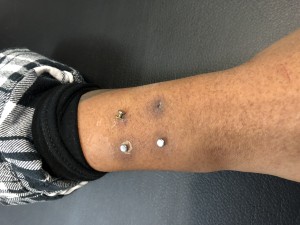
Surface anchors in different stages of rejection or removal.
In microdermals, early on bug with the piercing can be identified by a notable amount of swelling, irritation, excessive redness or soreness, and the jewelry no longer remaining "apartment" against the surface of the peel. At this stage, I would recommend returning to your piercer to accept them see if the problems may be able to be resolved on their own earlier furthering. In the subsequently stages, rejection may announced every bit the jewelry having tilted to i side or another, irritated tissue building up along the base of the jewelry, or entirely with parts of information technology protruding from the skin equally pictured. By this signal, information technology is a better idea to accept the piercing removed by a professional rather than go along to let it work its way out on its own.
RT: Would you recommend clients getting this kind of piercing? Do a lot request it?
Television set: Despite a few recent manufactures, requests for microdermal and surface anchor piercings take actually drastically decreased in contempo years as more than and more clients and more than and more professional piercers are becoming aware of their impermanence, high likelihood of rejection and migration, and potential scarring afterwards the piercing has been removed.
I detect that the majority of people getting such piercings these days, especially on outer extremities such as wrists, hands, and fingers are those who were not offered a proper explanation of what to expect during healing or later on removal. These days, I remove far more microdermals than I insert.
When information technology comes to extremities, such as hands, fingers, toes and the similar, I exercise not recommend having them washed – and nor do the vast bulk of my colleagues. These areas are drastically more prone to infection, irritation, accidental communicable, snagging, and well-nigh all potential negatives that could happen to a piercing. Fifty-fifty the simple act of placing a hand into a pocket or downward a sleeve when putting on a T-Shirt tin turn into a complete ordeal as the piercing snags on clothing. Their longevity is dramatically reduced, and though you may see an increase or a large amount of photos of them being done – they are nearly always photos taken when the piercings were still brand new.
(Source: https://safepiercing.tumblr.com/post/89884031234/hey-if-youd-respond-this-privately-id-appreciate)
RT: Where might there be a better placement on the manus?
TV: Truthfully, there is not really a "meliorate" placement for any piercing on a manus. Over the few decades, some of the all-time professional body piercers in the world experimented with a myriad of placements for piercings located on the hands and fingers. In short, they virtually all failed with the exception of some very small and unique cases of sheer luck.
In summary, if yous understand the risks, the likelihood that they will not be permanent adornments, and are okay with potential scarring one time they have been removed – they can be a very fun, temporary addition to many different parts of the body. It is important to consult with a reputable piercer with much experience in this surface area beforehand who tin explain all of these factors to yous along with providing you a safe recommendation on placement options that will provide as much longevity as possible. Outliers volition however always be a factor. Finger microdermals may potentially last a decade nether the correct circumstances and with enough luck – and many readers may know people who have successful microdermal piercings for extended amounts of fourth dimension that may make them believe the success charge per unit is much higher – but it'due south important to recall that not everyone who jumps off of the Gilt Gate bridge dies.
If you're looking for a cute way to show off your love, sticking with traditional finger jewelry tends to piece of work much, much better – and I would hope that your matrimony or partnership lasts longer than the average microdermal or surface anchor on a finger. :)
———————————————————
And that my friends, is why pop civilization should just go on to report on pop civilisation.
Source: https://news.bme.com/
Posted by: bennettyourron1938.blogspot.com
0 Response to "Do You Get Free Monster If You Have The Logo Tattooed"
Post a Comment